
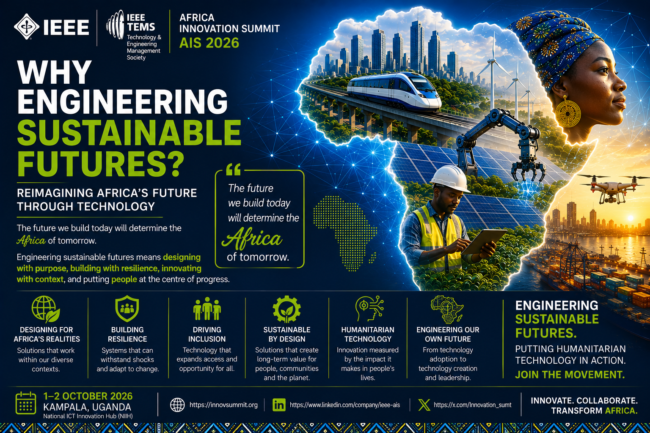
Across the continent, cities are expanding, industries are transforming, young people are embracing technology, entrepreneurs are creating new businesses, researchers are developing new solutions, and communities are finding innovative ways to respond to challenges around them.But as Africa moves forward, an important question must be asked:
What kind of future are we building?
Economic growth alone is not enough. Technological advancement alone is not enough. Infrastructure development alone is not enough. The future we build must be sustainable, inclusive, resilient and centred on people. This is the thinking behind the theme of the Africa Innovation Summit 2026: Engineering Sustainable Futures: Humanitarian Technology in Action
Engineering the Future, Not Just Adapting to It.
For much of Africa's development journey, technology has often been viewed as something to adopt; technologies developed elsewhere that can be introduced to address local challenges. But Africa's future presents an opportunity to think differently. What if Africa is not only a place where technologies are adopted, but a place where technologies are designed, engineered, tested, adapted, and scaled for the realities of its people? What if African engineers, researchers, entrepreneurs, students, industries, and communities become active architects of the technologies and systems that will shape the continent? This is what engineering sustainable futures is about. It is about moving from simply responding to today's challenges to designing systems capable of creating better outcomes for tomorrow.
Sustainability Must Go Beyond the Environment:
When we hear the word sustainability, we often think about climate change and environmental protection. These are essential. But sustainability is much broader. A sustainable future is one where infrastructure can withstand disruption, businesses can remain viable, communities can adapt to change, and people can access the opportunities created by technological progress.
Consider a digital health solution introduced into a community. Its success should not only be measured by how advanced the technology is. We should also ask: Can people access it? Can healthcare workers use it? Can it operate reliably within the available infrastructure? Can it be maintained? Can it grow to serve more communities? Can it continue creating value years after it is introduced? These are engineering questions but they are also questions about sustainability.
Designing for Africa's Realities
Africa is incredibly diverse. The challenges and opportunities in Lagos are different from those in Kampala. The realities of a rural farming community are different from those of a rapidly growing technology hub. Infrastructure, resources, skills, climate conditions, markets and social contexts vary considerably across the continent. This means that sustainable solutions cannot simply be copied and transferred without adaptation.
They must be designed with context in mind. African innovation has the opportunity to draw from local knowledge, local talent, local resources, and lived experiences to create solutions that are both relevant and scalable. The goal should not be to build technology for Africa without Africa. The opportunity is to build technology with Africa and increasingly from Africa.
Building Resilience Into the Future. Africa's future will also be shaped by how well the continent responds to uncertainty. Climate change is affecting agriculture, water resources, infrastructure, and livelihoods. Rapid urbanisation is increasing pressure on transportation, housing, energy, and public services. Digital transformation is creating new opportunities while introducing new questions around access, skills, security, and trust.
These challenges require more than short-term solutions. They require resilient systems, Infrastructure that can withstand shocks, Energy systems that can adapt to changing demand, Agricultural technologies that help communities respond to changing climates, Digital systems that remain accessible and reliable, Industries capable of adapting to technological and economic changes. Engineering sustainable futures means designing with these uncertainties in mind.
Technology Must Serve Humanity. This brings us to the second part of the theme: Humanitarian Technology in Action. Technology has extraordinary potential. Artificial intelligence can transform decision-making. Sensors can make infrastructure smarter. Robotics can transform manufacturing. Digital platforms can connect people to services and markets. Renewable energy can expand access to reliable power.
But technology itself is not the destination. Impact is. The real measure of innovation is what happens when an idea leaves the laboratory, enters the real world, and begins changing people's lives. Does it make healthcare more accessible? Does it help a farmer produce more sustainably? Does it create opportunities for young people? Does it make transportation safer and more efficient? Does it strengthen a community's resilience? Does it help an industry become more competitive? Does it improve the quality of life of the people it was designed to serve? These are the questions that place humanity at the centre of engineering and innovation.
A Future Engineered by Africans, for Africa and Beyond
Perhaps one of Africa's greatest opportunities is its people. A young and increasingly connected generation is entering engineering, science, technology, business, research, and entrepreneurship. This generation has the opportunity to approach old problems differently and to develop solutions for challenges that are not unique to Africa but are increasingly shared by the world.
African innovation can therefore have global relevance. Solutions developed to work in resource-constrained environments can demonstrate new approaches to affordability, efficiency, resilience, and accessibility. Africa does not have to wait for the future to arrive. Africa can help design it.
The Question We Must Ask; What future do we want to engineer for Africa? A future where technology widens inequality or one where it expands opportunity? A future where infrastructure struggles to keep pace with growth or one where infrastructure enables inclusive development? A future where Africa primarily consumes technology or one where African innovators help shape the technologies the world uses? A future focused only on economic growth or one where prosperity, resilience, inclusion, and human wellbeing advance together?
The choices we make today will influence the Africa of tomorrow. And engineering will play a central role in those choices.
Engineering sustainable futures means thinking beyond what technology can do and focusing on what technology should do. It means designing with purpose. Building with resilience. Innovating with context. And putting people at the centre of progress.
Africa's future is being engineered today.The question is: What will we build?